
Quick answer
An SMT is a divergence between two correlated assets. NQ and ES move together almost all the time, so when one sweeps a level and the other does not, that is the tell. But the divergence alone is not an entry. I validate it by waiting for a 15-minute fair value gap to invert, then I drop to a lower-timeframe inversion for the trade.
Introduction
SMT, the Smart Money Technique, is one of the cleanest reads on the chart and one of the most misused. People see a divergence and immediately buy or sell the low. That is not how I trade it. A sweep is not an entry. Here is how I figure out whether an SMT is actually high probability, step by step.
“NQ sweeps some sellside liquidity. ES does not take out that same low. We have a bullish SMT. That does not mean the SMT is valid yet for my trading. I am looking for confirmation.
”Kevin Dhesi · @dhesi_trades
What is an SMT?
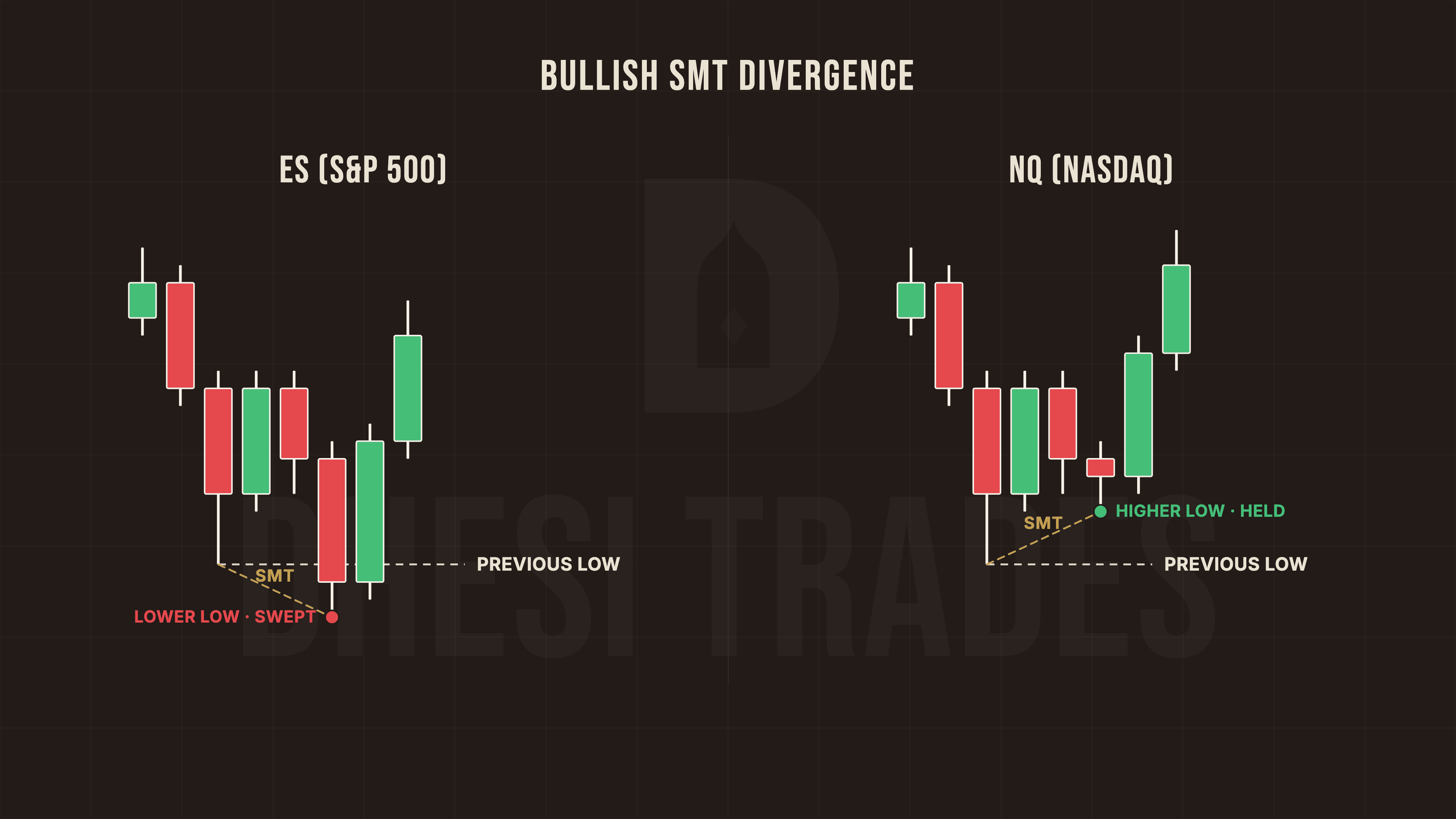
NQ (Nasdaq) and ES (S&P) are correlated. They move together the vast majority of the time. The SMT shows up when they disagree:
- One index sweeps the sellside, taking out a low.
- The other holds, refusing to take out the same low.
- That disagreement is a bullish SMT. One index got manipulated for liquidity, the other is showing the real direction. It works in either order: in the session quoted above NQ swept while ES held; in the figure below ES sweeps while NQ holds. Same signal.
The SMT Divergence
 Dhesi Trades
A sweep is not an entry
This is where most people go wrong. They see the divergence and buy the low. I do not. I am not looking for a turtle soup at the lows. That is not my style.
A divergence tells me which way to lean. It does not tell me to pull the trigger. For that, I need confirmation.
Confirmation: the inversion
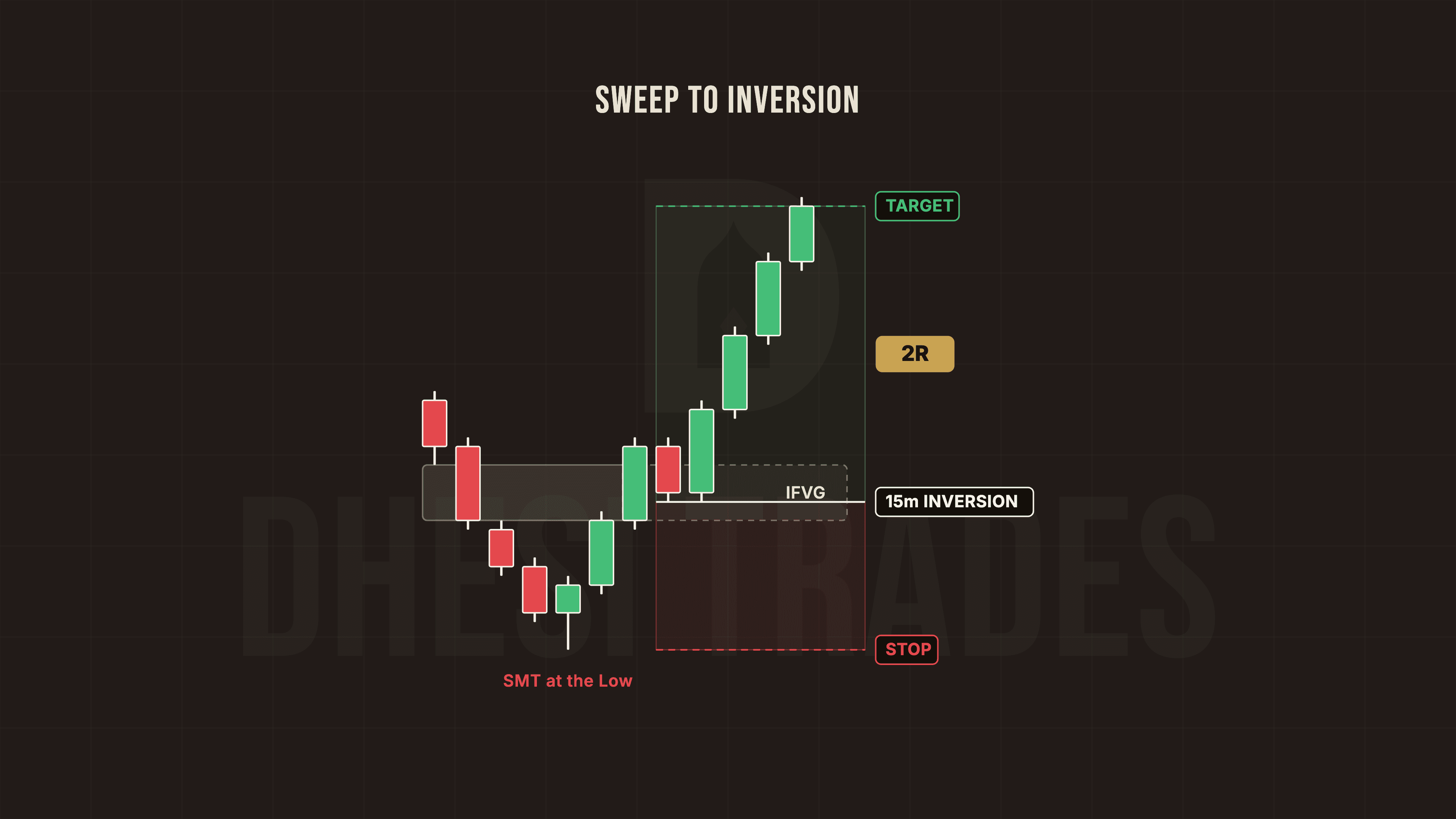
As the market recovers from the bullish SMT, I watch the 15-minute fair value gap it left behind. When price taps back into that gap and inverts it, that is my confirmation that the SMT is valid.
- Price rejects sellside and recovers.
- It taps the 15-minute fair value gap and inverts it.
- An inverted gap means the SMT is confirmed. Now I can hunt an entry.
Sweep, Then Confirm
 Dhesi Trades
The entry on the lower timeframe
Once the 15-minute gap inverts, I drop down. The inversion creates bullish PD arrays on the way up. I wait for price to tap back into one and trigger a 1 or 5-minute inversion. That is my entry, targeting the external buyside above.
- Watch NQ and ES at a key level. One sweeps, the other holds. That is the SMT.
- Note the direction. A bullish SMT means lean long, nothing more yet.
- Do not buy the sweep. No turtle soup. Wait for confirmation.
- Watch the 15-minute fair value gap. Price taps it and inverts it.
- The inversion validates the SMT. Now you can hunt the entry.
- Drop to the 1 or 5-minute for an inversion into a bullish PD array.
- Target the external buyside above. Stop below the structure that confirmed you.
When the SMT is not valid
- No inversion. A divergence with no 15-minute inversion is just a sweep. Skip it.
- You are buying the low. If your entry is the sweep itself, you are guessing, not confirming.
- The indices are in lockstep. No divergence, no SMT, no tell. Wait.
- No lower-timeframe trigger. Confirmation without a 1 or 5-minute inversion is still not an entry.
Bottom line
Sweep, divergence, confirmation, entry. One index sweeps, the other holds, and you have an SMT. But the sweep is not the trade. Wait for the 15-minute fair value gap to invert, let that confirm the SMT, then take the lower-timeframe inversion into buyside. That one filter, waiting for the inversion, is what separates a high-probability SMT from a guess.
It pairs directly with the importance of SMT. The NQ versus ES read runs live on the stream every morning.
“This is how I validate my SMT. A very simple way to understand where the SMT is actually valid or not, so you are not confused on whether the market continues or reverses.
”Kevin Dhesi